
The central question
What is this film about?
At its core, The Godfather Part II is a devastating critique of the American Dream, revealing its promise of upward mobility as a path to moral and spiritual ruin. The film presents a diptych of ascension and descent: Vito Corleone rises from a penniless immigrant to a powerful community patriarch, while his son, Michael, consolidates that power into a cold, corporate empire, losing his soul in the process. It's a story about the corrosion of character, where the pursuit of security and legitimacy requires a ruthlessness that ultimately destroys the very thing it seeks to protect: family. The American Dream is achieved, but the cost is everything that makes a life worth living.
Francis Ford Coppola expresses this tragic duality through the film's groundbreaking parallel structure. The narrative constantly cross-cuts between Vito's past and Michael's present. Vito's world is bathed in warm, golden, nostalgic light, suggesting a mythic, romanticized origin story rooted in community. In stark contrast, Michael's world is sterile, shadowy, and cold, dominated by dark interiors and icy landscapes. This formal choice isn't just stylistic; it creates a dialectic where the father's actions, however brutal, feel grounded, while the son's calculated moves feel like the hollow machinations of a ghost, forever haunted by a past he can neither replicate nor escape.
A common misreading is that the film glorifies mob life by contrasting the 'good' gangster, Vito, with the 'bad' one, Michael. This oversimplifies the profound moral ambiguity at play. Vito is no saint; his rise is built on murder and extortion. However, the film contextualizes his violence as a response to a society that failed him, positioning him as a founder of a shadow state. Michael is not simply 'more evil'; he is the logical endpoint of his father's enterprise, stripped of its communal rationalizations and assimilated into the impersonal, far-reaching cruelty of modern corporate capitalism. The film condemns the system, not just the man.
A quieter, alternative reading views the film as a tragedy of assimilation. Vito, the immigrant, builds an empire by recreating Old World Sicilian structures of patronage and loyalty in America. Michael, the Ivy League-educated war hero, attempts to fully assimilate the family into the legitimate American mainstream. His tragedy is realizing that the 'legitimate' world of politics and corporate enterprise operates on a code of betrayal and violence even more profound and less personal than his father's. In his quest to cleanse the family name, he adopts the very corruption he sought to transcend, proving that assimilation into this version of America is itself a form of damnation.
Editorial reading
Written by the FilmAbouts editors. It is one reading among many — the community decides how convincing it is.
Do you agree?
0% agree · 100% disagree
Visual language
Symbols & visual language
Recurring elements, where they appear, and what they might mean.
Doors
Represents
Exclusion, Power, and Isolation
Where it appears
Throughout the film, especially closing on Kay, or in Michael's office.
Doors separating business from family signify Michael's alienation. His power is defined by who is shut out, culminating in his complete emotional and physical isolation from everyone he once loved.
The Lake
Represents
Coldness and Death
Where it appears
The film's present-day timeline is set at Michael's compound on Lake Tahoe.
The vast, dark, cold water contrasts with the warm, vibrant streets of Vito's New York. It becomes the site of Fredo's murder, acting as a literal and symbolic graveyard for the family's warmth and bonds.
Oranges
Represents
Impending Doom and Death
Where it appears
Vito is buying oranges when he is shot; Fanucci eats an orange before he is killed; Johnny Ola brings Michael an orange from Roth.
Inherited from the first film, this visual motif links violence and betrayal across generations, acting as a recurring omen that connects Vito's world to the tragedies in Michael's.
The Family Photograph
Represents
A Lost Ideal
Where it appears
Michael looks at an old photograph of his father and siblings.
The photo represents the nostalgic, perhaps false, memory of family unity and strength that Michael believes he is protecting. His solitary contemplation of it underscores how his actions have destroyed the very ideal he cherishes.
Cinematography
How the film looks
Sepia Gold · Blood Red · Shadow Black · Winter Blue · Olive Drab
The film's palette is a study in contrasts, using warm, golden sepia tones to create a nostalgic, mythologized past for Vito's story. This is set against the cold, desaturated blues, grays, and oppressive blacks of Michael's contemporary timeline, visually manifesting his spiritual decay.
- Dominant colours
- A bifurcated scheme: warm, amber, and sepia tones for Vito's past; cold blues, stark blacks, and muted earth tones for Michael's present.
- Lighting
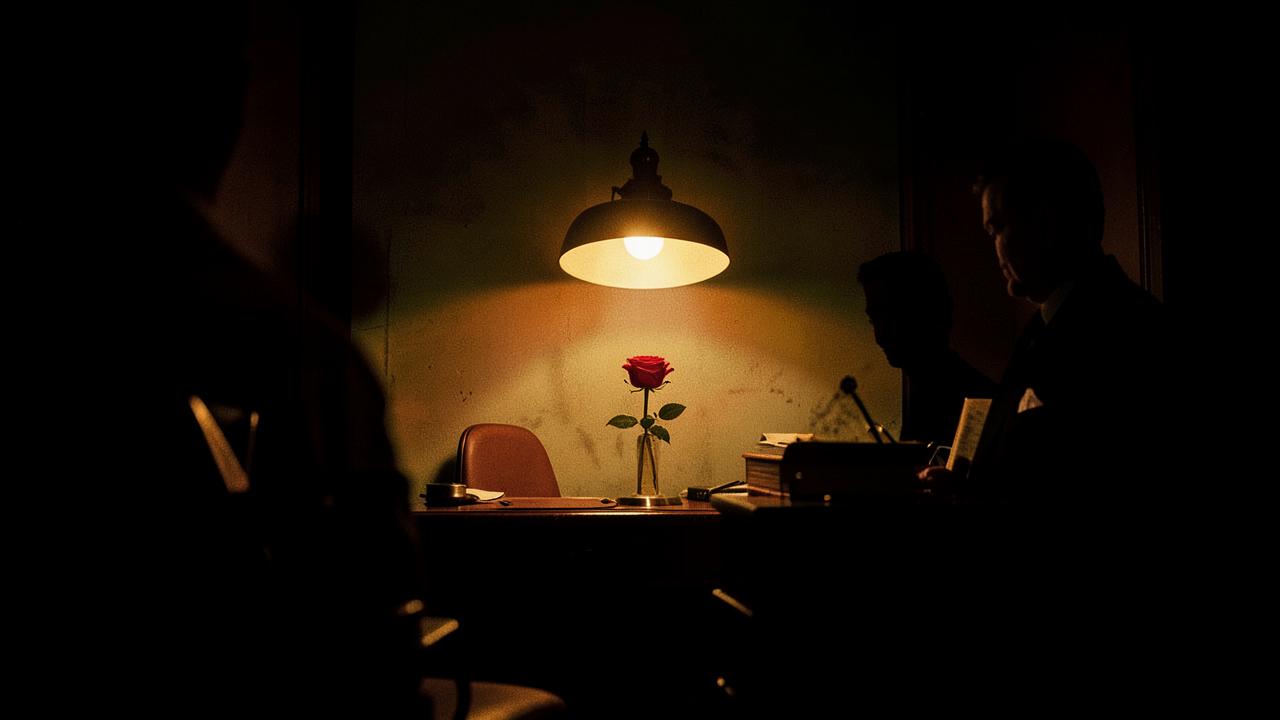
- Gordon Willis's masterful chiaroscuro. Top-lighting and heavy shadows obscure faces and environments, creating an atmosphere of moral ambiguity and psychological depth.
- Camera
- Formal and deliberate. Slow, methodical zooms and pans create a sense of gravitas and dread. The camera often maintains a formal distance, observing events with an operatic stateliness.
- Composition
- Precise, balanced, and often symmetrical. Characters are frequently framed by architecture (doorways, windows), suggesting entrapment and destiny.
- Aspect ratio
- 1.85:1
- Production design
- Immaculate period recreation. Vito's early 20th-century New York is textured and vibrant; Michael's 1950s world (Tahoe, Havana) is opulent but sterile and soulless.
- Recurring pattern
- The juxtaposition of religious ceremony (First Communion, a procession) with brutal violence, highlighting the characters' profound hypocrisy and moral corruption.
- Evolution
- The two timelines move in opposite visual directions. Vito's story progresses from dark poverty to warm, communal power. Michael's story begins in opulent light and descends into cold, isolated darkness.
Lineage
What inspired the film?
Films, books, real events and culture that feed into it.
Book
The Godfather by Mario Puzo (1969)
The film is a partial adaptation, using the novel's backstory for Vito Corleone's rise as its second narrative thread, while creating an original story for Michael's continuing journey.
Film
Citizen Kane (1941)
Coppola borrows structural and thematic elements, particularly the fractured narrative of a powerful man's rise and fall, culminating in lonely isolation within a vast, empty estate.
Real event
The Kefauver Committee Hearings (1950-1951)
The U.S. Senate committee hearings investigating organized crime served as the direct inspiration for the dramatic scenes where Michael and Pentangeli testify before Congress.
Culture
The American Dream
The film serves as a dark critique of the immigrant success story, portraying the pursuit of wealth and power in America as a Faustian bargain that requires the sacrifice of one's soul.
Real event
The Cuban Revolution (1959)
The historical overthrow of the Batista regime by Fidel Castro's forces provides the dramatic backdrop for the Havana sequence, shattering the mob's plans to expand their empire.
Connections
If you liked this film...
The Godfather
The essential first chapter. Part II functions as both a prequel and sequel, making the original indispensable for understanding the tragic arc of the Corleone family.

Chinatown
A contemporary masterpiece that also explores the rotten core of American expansion, revealing how power, capital, and family secrets corrupt everything they touch.

Goodfellas
Provides a stark contrast in gangster epics. Where Coppola's film is an operatic tragedy about the loneliness of power, Scorsese's is a frenetic, documentary-style look at the allure and decay of the criminal lifestyle from the ground up.
Films that influenced this film
- Citizen Kane (1941)
- The Leopard (1963)
- Rocco and His Brothers (1960)
Films influenced by this film
- Goodfellas (1990)
- The Sopranos (1999-2007)
- There Will Be Blood (2007)
Music
Soundtrack
Senza Mamma
Francesco Pennino
Where it appears
During the Little Italy street theatre play watched by Vito.
This Neapolitan song about an abandoned child mirrors Vito's own status as an orphan, underscoring the deep-seated loneliness that fuels his quest for family and power.
Main Title (The Immigrant)
Nino Rota
Where it appears
The opening sequence, as young Vito arrives at Ellis Island.
The iconic, mournful trumpet solo immediately establishes a tone of tragedy, destiny, and melancholy, framing Vito's American journey not as a triumph but as a sorrowful epic.
The Godfather Mazurka
Carmine Coppola
Where it appears
During the First Communion party at Lake Tahoe.
The traditional, festive folk dance music creates a powerful ironic counterpoint to the hollow celebration and the dark, treacherous plotting occurring just beneath the surface.
Guantanamera
Traditional
Where it appears
Played by the band at the New Year's Eve party in Havana, Cuba.
This famous Cuban patriotic song, celebrating the common man, plays as American mobsters and corporate heads carve up the country, highlighting their colonialist greed on the eve of revolution.
Spoilers ahead
The ending
Spoiler warning
This section reveals the ending and its possible meanings.
Easter eggs
Hidden details
Small discoveries most viewers miss on a first watch.
De Niro's Method
To prepare for the role of young Vito Corleone, Robert De Niro lived in Sicily for three months and spent the entire shoot speaking only the Sicilian dialect he had learned, both on and off camera.
A Real Pentangeli?
The character of Frank Pentangeli is heavily based on the real-life testimony of mobster Joe Valachi, whose televised appearance before a Senate committee in 1963 was a major public event.
The First Sequel
The Godfather Part II was the first sequel in history to win the Academy Award for Best Picture. The original film had won the same award two years prior.
Strasberg's Audition
Legendary acting coach Lee Strasberg, who played Hyman Roth, initially refused the role. Al Pacino encouraged him to reconsider, and Coppola was so impressed by his reading that he offered him the part on the spot.
The debate
Competing interpretations
The goal is not a correct answer — it's finding out which reading people find most convincing.
FilmAbouts interpretation
0%
Community
What do you think the film is about?
Ranked automatically by community agreement.
Log in to add your own interpretation.