
The central question
What is this film about?
At its core, “Apocalypse Now” is a cinematic descent into the madness engendered by the moral absurdity of war. It uses the Vietnam conflict not as a historical backdrop, but as a symbolic landscape for a journey into the human soul’s “heart of darkness.” Captain Willard’s mission to terminate Colonel Kurtz is a physical trip upriver, yet it functions as a psychological pilgrimage into a primal state where the thin veneer of civilization is brutally stripped away. The film posits that in the crucible of total war, sanity is a casualty and the 'savage' instincts Kurtz embraces are not an aberration, but a dormant truth within all humanity.
Francis Ford Coppola’s hallucinatory form is inseparable from the film's meaning. The protracted, overlapping dissolves visually merge Willard’s psyche with the jungle’s chaos, suggesting an internal and external collapse. The sound design, famously blending helicopter blades with a ceiling fan, immediately grounds the war within Willard’s traumatized mind. Epic, often surreal cinematography, from the Wagnerian helicopter assault to the chiaroscuro hell of Kurtz's compound, eschews realism for a nightmarish, operatic quality. The filmmaking doesn't just depict a journey; it immerses the viewer in a state of sensory and moral disorientation, mirroring Willard's own unraveling experience.
A common misreading of the film is to view it as a straightforward anti-war protest or a docudrama about the Vietnam War. While it certainly contains potent anti-war sentiment, its ambitions are more mythic and philosophical. The film is less concerned with the specific geopolitics of the conflict than with using Vietnam as a stage for a grand, allegorical tragedy about the universal human capacity for savagery when removed from societal judgment. It is not a polemic demanding an end to a specific war, but a despairing look at the darkness that war itself unleashes within the warrior.
A quieter, alternative reading positions “Apocalypse Now” as a profound meditation on myth-making and the power of narrative. Willard constructs a legend of Kurtz from a dossier of intelligence reports, photographs, and tapes long before he meets the man himself. The entire film is structured around such exaggerated stories, from Kilgore’s surfing obsession to the pagan kingdom Kurtz has built. It explores how human beings create stories and myths to make sense of the incomprehensible, and how those narratives—of heroism, madness, and godhood—can become more potent and real than the flawed individuals at their center.
Editorial reading
Written by the FilmAbouts editors. It is one reading among many — the community decides how convincing it is.
Do you agree?
0% agree · 100% disagree
Visual language
Symbols & visual language
Recurring elements, where they appear, and what they might mean.
The Nung River
Represents
A journey into the subconscious
Where it appears
Throughout the film as the primary setting for the journey.
The further the patrol boat travels up the winding river, the further the crew moves from civilization and conventional morality, descending deeper into a primal, pre-social state.
Fog
Represents
Moral ambiguity and the unknown
Where it appears
During the Do Lung Bridge sequence and as the boat approaches Kurtz's compound.
The literal fog obscures vision and direction, mirroring how the mission's purpose, the nature of the enemy, and the lines between sanity and madness become completely blurred for Willard.
Kurtz's Dossier
Represents
Constructed narratives and myth-making
Where it appears
Willard reads from the dossier throughout the first half of the film.
The file is Willard's only access to Kurtz, building him into a legendary, almost supernatural figure. It highlights how we create our heroes and monsters from fragmented stories, often detached from reality.
Helicopters
Represents
The god-like, impersonal power of the American war machine
Where it appears
Frequently, most memorably during the 'Ride of the Valkyries' attack.
The helicopters are instruments of both salvation and apocalyptic destruction, descending from the sky to dispense death with a terrifying detachment from the carnage on the ground.
Cinematography
How the film looks
Napalm Orange · Jungle Green · Flare Red · River Brown · Shadow Black
The film's palette moves from the saturated, chaotic colours of the war's spectacle—napalm orange and psychedelic flares—to the deep, chiaroscuro darkness of Kurtz's compound. This visual shift perfectly maps Willard's journey from the external chaos of conflict to the internal heart of darkness.
- Dominant colours
- Saturated oranges and greens, deep impenetrable blacks, and the lurid reds, purples, and yellows of smoke and signal flares.
- Lighting
- Moves from the harsh, naturalistic light of day to highly stylized, expressionistic low-key lighting (chiaroscuro) in Kurtz's compound, creating a world of shadow and silhouette.
- Camera
- Hypnotic, slow camera movements, extensive use of long dissolves and superimpositions, epic helicopter-mounted tracking shots, and intense, invasive close-ups.
- Composition
- Operatic, often symmetrical compositions that feel mythic and grand. Characters are frequently dwarfed by the landscape or shrouded in shadow to emphasize their psychological state.
- Aspect ratio
- 2.39:1
- Production design
- Begins with hyper-realistic military bases and equipment, which gradually degrades and is replaced by the pagan, skull-adorned, nightmarish iconography of Kurtz's Cambodian compound.
- Recurring pattern
- The superimposition of Martin Sheen's face over images of fire, explosions, and jungle landscapes, visually merging his internal psyche with the external chaos.
- Evolution
- The film's visual style evolves from a gritty, verité-adjacent war film into a surreal, dreamlike, and theatrical opera as the boat moves further up the river.
Lineage
What inspired the film?
Films, books, real events and culture that feed into it.
Book
Heart of Darkness by Joseph Conrad (1899)
The film's narrative structure, character archetypes (Willard/Marlow, Kurtz), and central theme of a journey into a primal wilderness to confront a rogue figure are directly transposed from Conrad's novella.
Book
The Golden Bough by Sir James Frazer (1890)
Frazer's anthropological study of myth, ritual, and the 'slaying of the king' directly informs the film's climax, framing Kurtz's death as a ritualistic transfer of power. A copy of the book sits in Kurtz's compound.
Poem
The Hollow Men by T.S. Eliot (1925)
Kurtz recites lines from the poem, aligning his own nihilistic despair with Eliot's modernist vision of a spiritually bankrupt world. A copy of Eliot's work is also seen in his compound.
Real event
The Vietnam War (1955-1975)
The film uses the specific setting, technology, and psychological trauma of the American experience in Vietnam as the canvas for its more universal, allegorical story about the nature of war itself.
Film
Aguirre, the Wrath of God (1972)
Werner Herzog's film, about a conquistador's descent into madness on a South American river journey, was a major thematic and visual influence, particularly in its depiction of obsession and the overwhelming power of the jungle.
Connections
If you liked this film...

Stalker
Both are slow, metaphysical journeys into a forbidden 'Zone' where the normal rules of reality break down, led by a guide towards a destination that promises to reveal a profound, perhaps unbearable, truth.
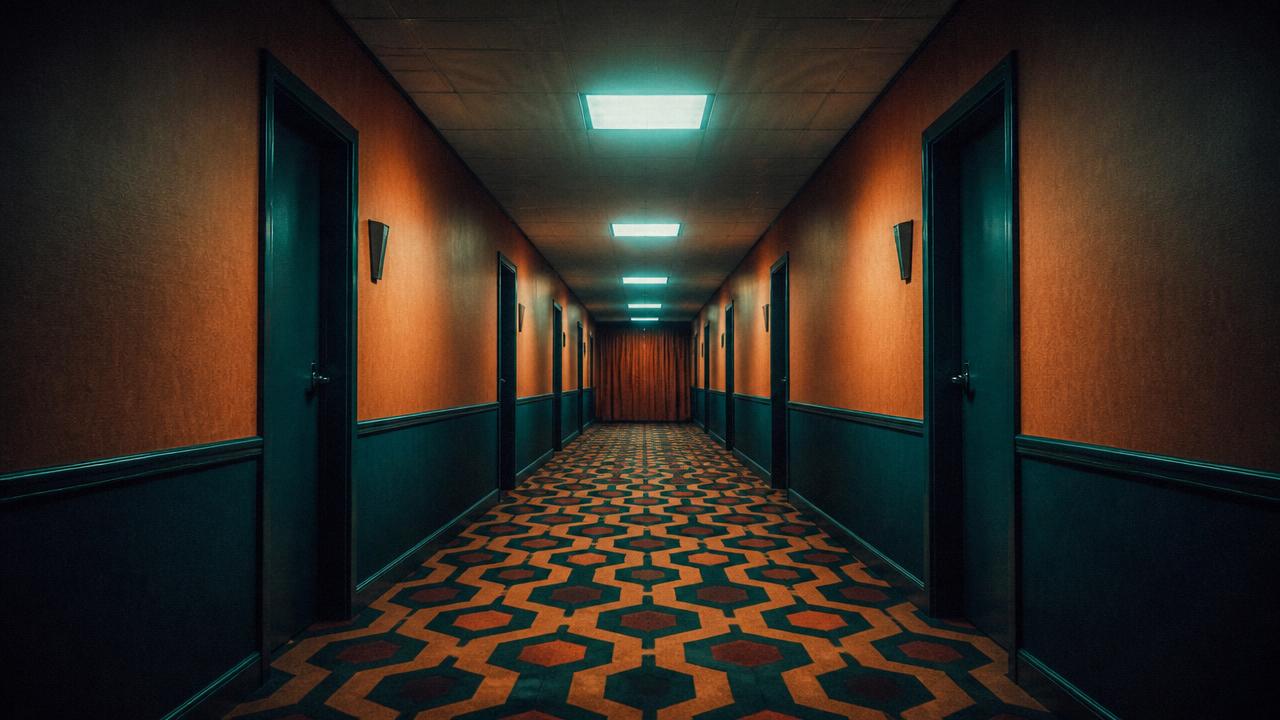
The Shining
Explores a descent into madness within an isolated, malevolent environment, blurring the lines between psychological collapse and the supernatural, and centering on a man tasked with a job who ultimately succumbs to the location's dark energy.

Full Metal Jacket
Another seminal Vietnam film that deconstructs the dehumanizing process of military conditioning and the psychological schism between the ideal of a soldier and the absurd, brutal reality of combat.
Films that influenced this film
- Aguirre, the Wrath of God (1972)
- 2001: A Space Odyssey (1968)
- Lawrence of Arabia (1962)
Films influenced by this film
- Platoon (1986)
- Jarhead (2005)
- Mad Max: Fury Road (2015)
Music
Soundtrack
The End
The Doors
Where it appears
The opening sequence, as Willard has a breakdown in his Saigon hotel room.
Its hypnotic, apocalyptic lyrics and themes of death and transgression perfectly establish the film's tone as a journey towards a terrible, inevitable conclusion.
Ride of the Valkyries
Richard Wagner
Where it appears
Blasted from helicopters during the Air Cavalry's attack on a Vietnamese village.
Used diegetically by Kilgore, it transforms a brutal attack into a terrifying, surreal opera, highlighting the American military's god-like sense of detachment and theatrical cruelty.
(I Can't Get No) Satisfaction
The Rolling Stones (cover version)
Where it appears
Played by a local band during the USO show just before the Playmates arrive.
The song's theme of frustrated desire underscores the absurdity of importing American consumer culture into the warzone, foreshadowing the chaotic riot that erupts.
Suzie Q
Dale Hawkins
Where it appears
Played on the radio during the Playboy Playmates' desperate performance for the crew on the PBR Streetgang.
The raw, driving rock-and-roll track underscores the primal, sexual desperation of the soldiers, who are starved for any connection to the world and women they left behind.
Spoilers ahead
The ending
Spoiler warning
This section reveals the ending and its possible meanings.
Easter eggs
Hidden details
Small discoveries most viewers miss on a first watch.
The Real Water Buffalo
The water buffalo ritually slaughtered near the film's climax was a real animal, killed with a machete as part of a local Ifugao tribal ceremony that the production documented. This scene caused significant controversy with animal rights groups.
Martin Sheen's Heart Attack
During the notoriously difficult production in the Philippines, lead actor Martin Sheen, a heavy smoker, suffered a near-fatal heart attack. His younger brother, Joe Estevez, was flown in to stand in for him in some long shots and even provided some voice-over narration.
Harvey Keitel was the first Willard
Harvey Keitel was originally cast as Captain Willard and filmed for several weeks. Francis Ford Coppola felt his performance was too active and confrontational for the passive observer he envisioned, so he fired Keitel and replaced him with Martin Sheen.
Brando's Improvisation
Marlon Brando arrived on set massively overweight and having not read the script or the source novel. Coppola spent days reading 'Heart of Darkness' to him and discussing the character, leading to Brando improvising much of his dialogue, including the iconic 'horror' monologue.
The debate
Competing interpretations
The goal is not a correct answer — it's finding out which reading people find most convincing.
FilmAbouts interpretation
0%
Community
What do you think the film is about?
Ranked automatically by community agreement.
Log in to add your own interpretation.