
Sci-Fi / Neo-noir
Blade Runner
1982 · Ridley Scott
“A burnt-out cop hunts escaped replicants who just want more life.”
The central question
What is this film about?
At its core, Blade Runner is a profound and melancholic meditation on what it means to be human. In a future where synthetic beings, or 'replicants,' are nearly indistinguishable from people, the film dismantles traditional definitions of humanity. It posits that memory, emotion, and even empathy can be manufactured, forcing the protagonist, Deckard, and the audience to question the very bedrock of identity. The central conflict is not a simple cops-and-robbers chase, but an existential inquiry. Roy Batty’s desperate, violent quest for 'more life' is tragically human, while Deckard's weary, detached execution of his duty feels chillingly robotic.
The film’s neo-noir aesthetic is the primary vehicle for its philosophical themes. Ridley Scott and cinematographer Jordan Cronenweth drench Los Angeles in perpetual night and acid rain, creating a world of moral ambiguity and decay. High-contrast lighting, with deep shadows and piercing shafts of light, visually represents the story's central mystery: what is real and what is artificial? The slow, contemplative pace and densely layered production design overwhelm the senses, mirroring the characters' own confusion and alienation. This is not a future of sleek minimalism, but one of cluttered, retrofitted decay, where technology has festered rather than progressed.
A common reduction of Blade Runner is to treat it purely as a puzzle box whose only question is 'Is Deckard a replicant?'. While the evidence, particularly in later cuts, leans heavily toward an affirmative answer, focusing solely on this binary misses the film's true power. The narrative is designed to function through its ambiguity. The point is not to solve the riddle of Deckard's origin, but to experience his dawning horror that the line between himself and his quarry is dissolving. The film's genius lies in making the audience feel this uncertainty, forcing us to abandon our own clear-cut definitions of selfhood.
A quieter, yet equally potent, reading of Blade Runner is as a critique of corporate power and end-stage capitalism. The Tyrell Corporation is the film's true antagonist—a godlike entity that manufactures sentient beings as a slave class for off-world colonization. The replicants are not merely monsters; they are a rebelling proletariat, products fighting their manufacturer. The dystopian landscape of Los Angeles, choked with pollution and monolithic advertisements, is a direct consequence of this corporate overreach. It is a world where life itself has been commodified, and the ensuing moral and environmental rot is the price of 'progress'.
Editorial reading
Written by the FilmAbouts editors. It is one reading among many — the community decides how convincing it is.
Do you agree?
0% agree · 100% disagree
Visual language
Symbols & visual language
Recurring elements, where they appear, and what they might mean.
Eyes
Represents
Identity, The 'Window to the Soul', Artificiality
Where it appears
Throughout the film, from the Voight-Kampff test's focus on pupils to the creation of eyes by Chew, to Roy's meeting with Tyrell.
Eyes are the traditional marker of humanity and emotion, but in Blade Runner, they are also a point of failure and a sign of the synthetic, making them an unreliable gauge of authenticity.
Origami Animals
Represents
Fragility of Identity, Observation, Foreknowledge
Where it appears
Gaff creates a chicken, a stick figure, and finally a unicorn, leaving them for Deckard at key moments.
Each figure comments on Deckard's state: cowardice (chicken), compromised humanity (stick figure), and finally, his artificial nature (unicorn), revealing that Deckard's inner life is known to others.
Photographs
Represents
Manufactured Memory, The Need for a Past
Where it appears
Leon's 'precious photos' and Rachael's childhood pictures, which Deckard proves are implants from Tyrell's niece.
The replicants' desperate clinging to photos underscores the idea that a personal history, even a fake one, is essential for a sense of self, highlighting their tragic, rootless existence.
The Chess Game
Represents
Creator vs. Creation, Intellectual Warfare
Where it appears
J.F. Sebastian and Tyrell play a remote game of chess, which Roy Batty intervenes in and wins to gain an audience with Tyrell.
The game symbolizes the 'endgame' between man and machine. Roy, the creation, checkmates his 'king,' Tyrell, demonstrating intellectual superiority and sealing his creator's fate.
Cinematography
How the film looks
Noir Blue · Neon Cyan · Amber Light · Smog Brown · Asphalt Black
The palette is defined by a conflict between organic decay and artificial brilliance, setting the cold blues and blacks of a dying city against the harsh, vibrant glow of neon. This visual tension mirrors the film's core theme of natural versus synthetic life.
- Dominant colours
- Deep blacks and blues punctuated by vibrant neon (cyan, red, yellow) and amber interior light.
- Lighting
- High-contrast chiaroscuro, 'future noir' style. Heavy use of backlighting, shafts of light cutting through smoke and darkness, lens flares.
- Camera
- Slow, deliberate tracking and panning shots that absorb the dense environment. Static compositions that feel like paintings. Use of extreme close-ups on eyes.
- Composition
- Densely layered frames, often cluttered with detail. Strong vertical and horizontal lines from massive architecture contrasted with chaotic street-level mess.
- Aspect ratio
- 2.39:1 (Panavision anamorphic), emphasizing the vast, oppressive cityscapes.
- Production design
- Retrofitted futurism. A decaying 20th-century urban landscape overlaid with futuristic technology, advertising, and multicultural influences.
- Recurring pattern
- Light filtering through blinds or vents, creating striped patterns on characters, suggesting entrapment or a fractured identity.
- Evolution
- The film maintains its grim, shadowy aesthetic throughout. There is no visual evolution towards clarity or hope; the final scenes are as dark and ambiguous as the first.
Lineage
What inspired the film?
Films, books, real events and culture that feed into it.
Book
Do Androids Dream of Electric Sheep? by Philip K. Dick (1968)
The film's source material, providing the central premise of a bounty hunter retiring androids, though the film significantly shifts the focus towards existential themes over the novel's plot.
Film
Metropolis (1927)
Fritz Lang's vision of a towering, socially stratified city of the future is a clear architectural and thematic ancestor to Blade Runner's Los Angeles.
Art
Nighthawks by Edward Hopper (1942)
The painting's mood of lonely, nocturnal observation within a rain-slicked city directly influenced the film's neo-noir atmosphere and feeling of urban isolation.
Film
Chinatown (1974)
Its cynical, neo-noir tone, morally ambiguous detective protagonist, and themes of deep-seated corruption provided a crucial template for Blade Runner's mood and characterization.
Culture
Hong Kong's Kowloon Walled City
The hyper-dense, chaotic, and layered urban environment of late-20th century Hong Kong served as a primary visual inspiration for the film's street-level scenes.
Connections
If you liked this film...
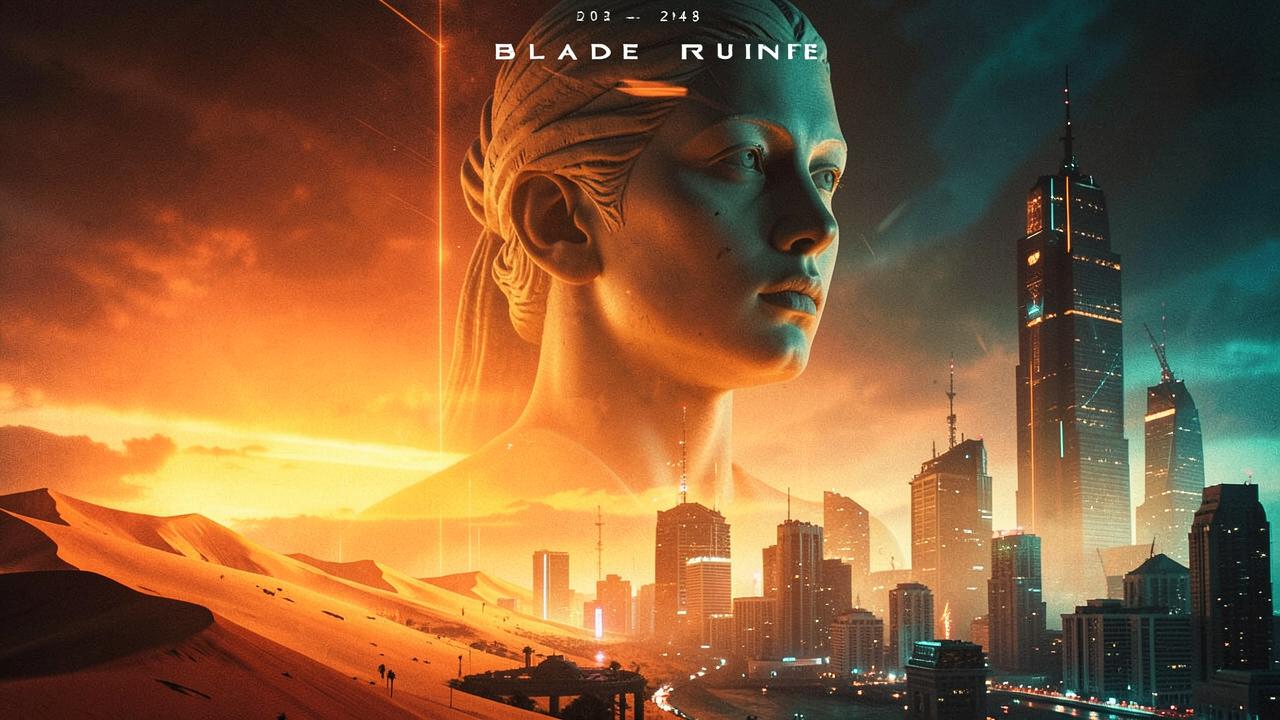
Blade Runner 2049
The direct sequel, which masterfully expands upon the original's themes of identity, memory, and artificial life while maintaining its distinct, melancholic tone and visual grandeur.

Akira
A landmark of dystopian cyberpunk featuring a stunningly realized, rain-soaked megalopolis, societal decay, and characters grappling with powers beyond their control.

Stalker
Another slow-burning, philosophical science fiction masterpiece that eschews action for deep metaphysical questions about faith, existence, and the nature of desire.
Films that influenced this film
- Metropolis (1927)
- The works of French comic artist Jean 'Moebius' Giraud
- Chinatown (1974)
Films influenced by this film
- Ghost in the Shell (1995)
- The Matrix (1999)
- The entire Cyberpunk genre of fiction and video games
Music
Soundtrack
Main Titles
Vangelis
Where it appears
The opening sequence, flying over the industrial hellscape of 2019 Los Angeles.
The majestic, synth-heavy score immediately establishes a tone of technological grandeur mixed with profound dread, perfectly defining the film's epic scale and dystopian mood.
Blade Runner Blues
Vangelis
Where it appears
As Deckard contemplates his life and work alone in his apartment.
This melancholic saxophone solo over a synthesized backdrop is the sonic embodiment of the 'future noir' detective: isolated, world-weary, and haunted by his profession.
Tears in Rain
Vangelis
Where it appears
During Roy Batty's final monologue on the rooftop as he dies.
The gentle, ethereal synth music lends a sense of grace and transcendence to Batty's death, elevating his final moments into a profound statement on memory and existence.
Love Theme
Vangelis
Where it appears
During Deckard and Rachael's first intimate scene in his apartment.
The tender saxophone melody introduces a fragile, tentative romanticism into the cold world, but its melancholy undertones suggest the doomed nature of their connection.
Spoilers ahead
The ending
Spoiler warning
This section reveals the ending and its possible meanings.
Easter eggs
Hidden details
Small discoveries most viewers miss on a first watch.
The Alien Connection
A computer screen readout in Deckard's Spinner car briefly displays a 'Purge' instruction for a crew member of the ship Nostromo, explicitly linking the film to Ridley Scott's 'Alien' (1979) as a shared universe.
The Frank Lloyd Wright Connection
Deckard's apartment is a real location: the Ennis House in Los Angeles, designed by famed architect Frank Lloyd Wright in 1924. Its distinctive Mayan Revival concrete blocks were also used for interiors.
The Unscripted Monologue
While the concept was in the script, Rutger Hauer significantly rewrote and improvised parts of Roy Batty's iconic 'Tears in Rain' monologue the night before shooting, adding the final, poetic line himself.
The Original Blade Runner
The film's title is not from the Philip K. Dick novel, but was purchased from the rights to Alan E. Nourse's 1974 novel 'The Bladerunner,' a medical dystopia story which has no other plot relation to the film.
The debate
Competing interpretations
The goal is not a correct answer — it's finding out which reading people find most convincing.
FilmAbouts interpretation
0%
Community
What do you think the film is about?
Ranked automatically by community agreement.
Log in to add your own interpretation.