The central question
What is this film about?
Interstellar dresses itself as a survival epic about a dying planet, but every structural decision serves a domestic story: a father leaves, a daughter waits, and the cost is measured in years neither of them can get back.
The film's controversial claim — that love is a measurable dimension — is easier to accept as a claim about attention. Cooper solves the equation because he cares enough to keep looking at one bookshelf in one bedroom. Meaning is presented as a function of what you refuse to stop caring about.
The bleakest reading is that the film is about generational betrayal: Brand's lie, Mann's cowardice, and a father's promise that time makes impossible to keep.
Editorial reading
Written by the FilmAbouts editors. It is one reading among many — the community decides how convincing it is.
Do you agree?
0% agree · 100% disagree
Visual language
Symbols & visual language
Recurring elements, where they appear, and what they might mean.
Dust
Represents
Time, entropy, inheritance
Where it appears
The farm, the bedroom, the final station
The message arrives written in the substance that is killing them.
The watch
Represents
Promise and delay
Where it appears
Given at departure, decoded decades later
The gift is worthless as a clock and priceless as a channel.
The bookshelf
Represents
The wall between generations
Where it appears
Murph's bedroom, from both sides
The film's central image: a parent pressing on the back of a wall, hoping to be felt.
Cinematography
How the film looks
Dust ochre · Void black · Ice white · Cold blue
Earth is warm, dry ochre. Space is monochrome black and white. The colour drains out of the film exactly as the family does.
- Dominant colors
- Ochre earth, achromatic space
- Lighting
- Natural light on Earth, single-source starlight in space
- Camera
- IMAX 65mm, rig-mounted POV on the craft, almost no CG establishing shots
- Composition
- Human figures dwarfed; faces held in tight close-up for emotion
- Aspect ratio
- Mixed 2.39:1 and 1.43:1 IMAX
- Production design
- Practical sets and functional, unglamorous spacecraft
- Recurring pattern
- Silence used where blockbuster convention expects score
- Evolution
- Frames widen in space and close in again at the reunion
Lineage
What inspired the film?
Films, books, real events and culture that feed into it.
Film
2001: A Space Odyssey (1968)
The template it argues with — Kubrick's coldness answered with sentiment.
Book
'Do not go gentle into that good night' — Dylan Thomas
Recited as the film's thesis on refusal.
Real event
The American Dust Bowl
Interview footage of real survivors opens the film.
Culture
Kip Thorne's relativity research
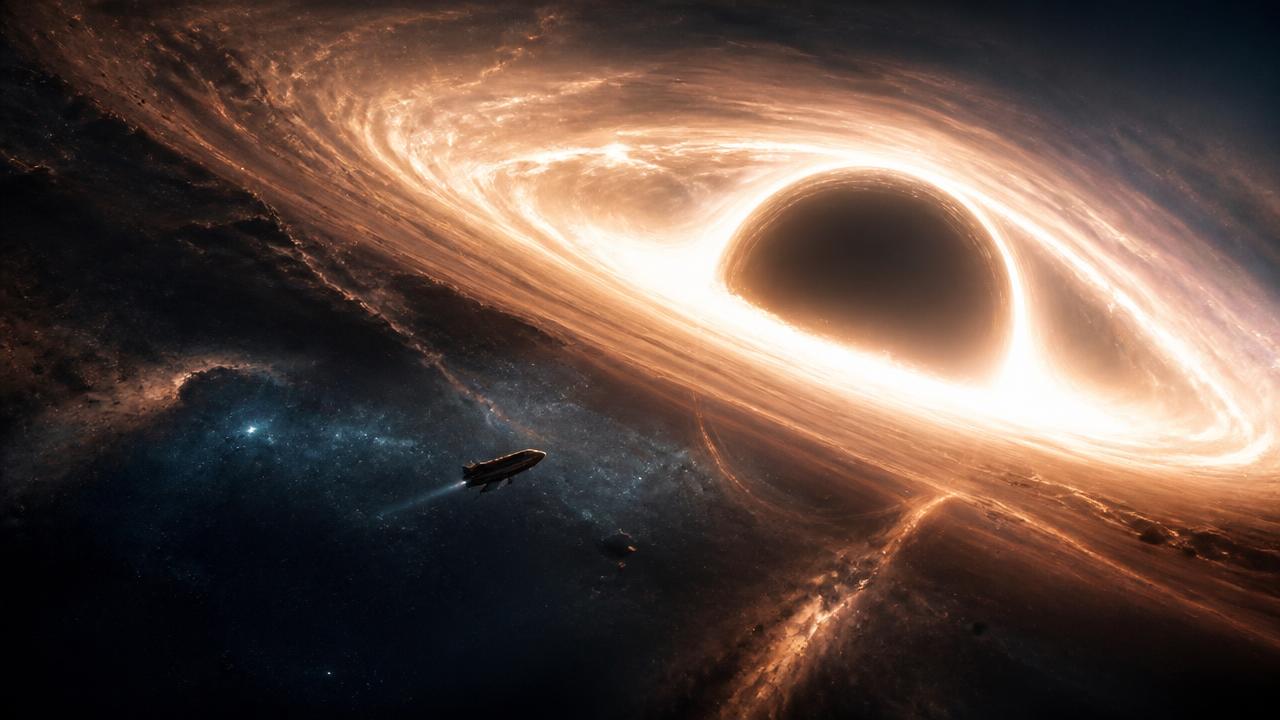
The black hole visual was produced from actual equations.
Connections
If you liked this film...
The Matrix
Belief treated as a physical force.
Fight Club
A high-concept exterior hiding a story about loss.
Films that influenced this film
- 2001: A Space Odyssey (1968)
- Solaris (1972)
- The Right Stuff (1983)
Films influenced by this film
- Ad Astra (2019)
- Arrival (2016)
Music
Soundtrack
Cornfield Chase
Hans Zimmer
Where it appears
The chase across the farm
Organ instead of orchestra — a church sound for a story about faith in physics.
Mountains
Hans Zimmer
Where it appears
Miller's planet
A literal ticking clock in the mix; the score becomes the antagonist.
Stay
Hans Zimmer
Where it appears
The departure
The word Murph shouts becomes the title of the music that leaves with him.
Spoilers ahead
The ending
Spoiler warning
This section reveals the ending and its possible meanings.
Easter eggs
Hidden details
Small discoveries most viewers miss on a first watch.
The ticking in 'Mountains'
Each tick equals one day passing on Earth.
TARS's humour setting
Set to 90% and quietly lowered — the film jokes less as it gets sadder.
Real corn
Five hundred acres were grown for the farm, then sold.
The debate
Competing interpretations
The goal is not a correct answer — it's finding out which reading people find most convincing.
FilmAbouts interpretation
0%
Community
What do you think the film is about?
Ranked automatically by community agreement.
Log in to add your own interpretation.