Sci-Fi / Action
The Matrix
1999 · Lana & Lilly Wachowski
“An allegory about awakening from an artificial reality and questioning the systems that control us.”
The central question
What is this film about?
The Matrix asks what it costs to see clearly. Its machinery is science fiction, but its argument is philosophical: a comfortable illusion will always outsell an uncomfortable truth, and most systems of control work by being pleasant enough to ignore.
The film has been claimed by almost every reading available — Gnostic, Marxist, Buddhist, trans. The Wachowskis have confirmed the last: Neo's story is a story of a person living under a name that isn't his, going through a transformation that the world around him treats as dangerous.
Its most durable idea is that liberation isn't a single moment. Neo takes the pill in act one; he spends the rest of the film failing, doubting and being told he isn't the one. Belief is portrayed as something you practise, not something you receive.
Editorial reading
Written by the FilmAbouts editors. It is one reading among many — the community decides how convincing it is.
Do you agree?
0% agree · 100% disagree
Visual language
Symbols & visual language
Recurring elements, where they appear, and what they might mean.
Mirrors
Represents
The dissolving boundary between selves
Where it appears
The pill scene; the spoon; reflective sunglasses
Every reflective surface in the film asks whether the image or the viewer is the copy.
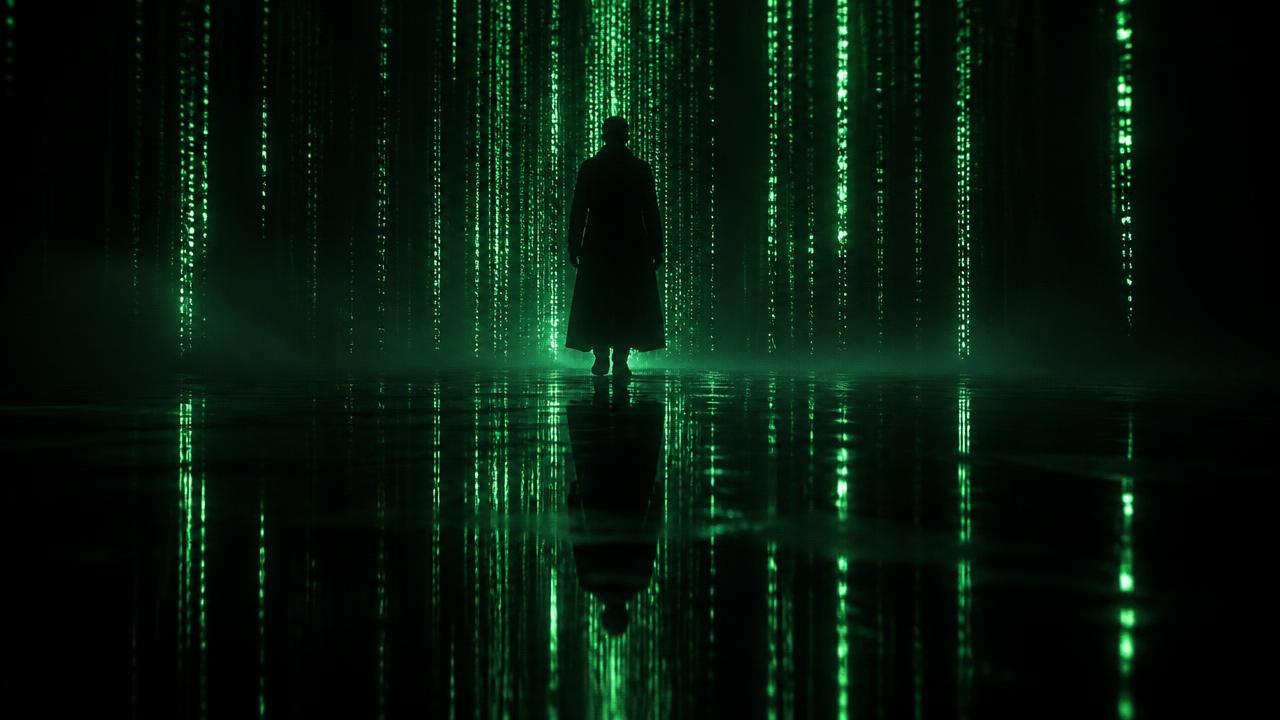
Green code
Represents
The manufactured world
Where it appears
All Matrix-set scenes
The illusion is tinted like an old monitor — nostalgia rendered as a prison.
The red pill
Represents
Irreversible knowledge
Where it appears
Morpheus's offer
Notably, the choice is offered, not forced. The film insists that seeing must be consented to.
Cinematography
How the film looks
Code green · Machine blue · Black · Steel grey
Inside the Matrix everything is green-filtered; the real world is cold blue. Once you notice, you always know which reality you are in without being told.
- Dominant colors
- Green interior world, blue exterior truth
- Lighting
- Hard top light, deep contrast, practical neon
- Camera
- Bullet-time rigs, wire work, anime-derived staging
- Composition
- Rigid symmetry for control, tilted frames for rupture
- Aspect ratio
- 2.39:1
- Production design
- Late-90s office banality against industrial machine gothic
- Recurring pattern
- Reflections that show a different truth than the scene
- Evolution
- The green filter weakens as Neo's belief strengthens
Lineage
What inspired the film?
Films, books, real events and culture that feed into it.
Book
Simulacra and Simulation — Jean Baudrillard
Appears on screen as a hollowed-out book in Neo's apartment.
Culture
Plato's Allegory of the Cave
The structural skeleton: shadows, escape, return.
Film
Ghost in the Shell (1995)
Direct visual template, including the falling code.
Book
Alice's Adventures in Wonderland
Quoted explicitly — the rabbit, the hole, the two choices.
Connections
If you liked this film...
Fight Club
Same year, same argument: your ordinary life is the fiction.
Interstellar
Both use hard science-fiction machinery to argue for love as knowledge.
Films that influenced this film
- Ghost in the Shell (1995)
- Dark City (1998)
- Akira (1988)
Films influenced by this film
- Inception (2010)
- Everything Everywhere All at Once (2022)
Music
Soundtrack
Wake Up
Rage Against the Machine
Where it appears
End credits
Turns the film's final line into an instruction aimed at the audience.
Clubbed to Death
Rob Dougan
Where it appears
The woman in the red dress
Orchestral loop over a training simulation: beauty revealed as programming.
Main Title
Don Davis
Where it appears
Opening
Brass clusters that never resolve — the sound of a system running.
Spoilers ahead
The ending
Spoiler warning
This section reveals the ending and its possible meanings.
Easter eggs
Hidden details
Small discoveries most viewers miss on a first watch.
Every Matrix scene is green-tinted
No exceptions, including flashbacks — the filter is a plot device disguised as a mood.
Neo's passport expires 11 September 2001
A coincidence that later reframed the film for a generation of viewers.
Doorways and thresholds
Characters are almost always framed inside doorframes before a change in belief.
The debate
Competing interpretations
The goal is not a correct answer — it's finding out which reading people find most convincing.
FilmAbouts interpretation
0%
Community
What do you think the film is about?
Ranked automatically by community agreement.
Log in to add your own interpretation.