
Drama / Thriller
Fight Club
1999 · David Fincher
“A man so hollowed out by consumer life that he invents a second self to burn it all down.”
The central question
What is this film about?
Fight Club can be interpreted as a story about a man who becomes so disconnected from his identity and purpose that he creates an alternate personality to escape the consumerist life he feels trapped inside. The film is less interested in violence than in what the violence is standing in for: a search for sensation in a life that has been fully furnished and completely emptied.
Fincher frames the narrator's apartment like a catalogue spread — captions floating over furniture — because that is how the character has learned to read himself. He is a set of purchases. Tyler Durden arrives as the fantasy of the opposite: a man with no possessions, no attachments, no fear. The seduction of the film is that Tyler is right about the diagnosis and catastrophically wrong about the cure.
The most common misreading treats the film as an endorsement of Tyler's philosophy. Read closely, the film is a satire of it. Project Mayhem replaces one system of conformity with another, complete with uniforms, chants and the erasure of individual names. The narrator escapes a corporation and immediately builds a cult.
There is also a quieter reading: the film is about grief for a self that never existed. Marla is the only character who sees the narrator as an actual person rather than a project, which is exactly why he cannot tolerate her until the final frame.
Editorial reading
Written by the FilmAbouts editors. It is one reading among many — the community decides how convincing it is.
Do you agree?
0% agree · 100% disagree
Visual language
Symbols & visual language
Recurring elements, where they appear, and what they might mean.
Soap
Represents
Cleansing, commodification, violence disguised as luxury
Where it appears
Tyler's kitchen; the liposuction clinic raids; the gift to Marla
Fat taken from wealthy bodies is sold back to them as beauty. The most cynical object in the film is also its idea of purification.
IKEA catalogue
Represents
Identity as inventory
Where it appears
The apartment sequence, rendered as a walk-through advertisement
The narrator can describe his sofa in more detail than he can describe himself. When the apartment explodes, the person does not survive it — because there was no person underneath.
Mirrors and doubles
Represents
Split identity, distorted perception
Where it appears
Bathroom scenes, reflective surfaces, the security-camera footage
Every reflection quietly announces the twist. The film shows you the answer for two hours and trusts you not to look.
Blood and bruises
Represents
Proof of existence
Where it appears
The basement fights; the narrator's face at work
Pain is the only sensation the character trusts. Feeling something bad is treated as preferable to feeling nothing.
Cinematography
How the film looks
Bile green · Tungsten amber · Black · Bruise blue
The corporate world is lit in sickly fluorescent green, the basement in warm amber. The film literally makes the office look like an illness and the fight look like a hearth — a visual argument the script never has to state.
- Dominant colors
- Sickly green, tungsten amber, deep black
- Lighting
- Underlit interiors, hard practicals, almost no fill
- Camera
- Impossible digital moves, whip pans, restless handheld in fights
- Composition
- Cluttered frames early, symmetrical and empty late
- Aspect ratio
- 2.39:1
- Production design
- Catalogue minimalism versus the rotting Paper Street house
- Recurring pattern
- Single-frame Tyler splices before he 'appears'
- Evolution
- Grain and grime increase as the narrator's control decreases
Lineage
What inspired the film?
Films, books, real events and culture that feed into it.
Book
Fight Club — Chuck Palahniuk (1996)
The source novel, with a notably different, bleaker ending.
Book
Notes from Underground — Dostoevsky
The template for a narrator who argues himself into ruin.
Film
The Graduate (1967)
The final shot of two people sitting with what they just did.
Culture
Situationism & 'The Society of the Spectacle'
Debord's critique of life mediated by images runs under the whole film.
Real event
1990s corporate downsizing culture
The recall-formula monologue is drawn from real cost-benefit practice.
Connections
If you liked this film...
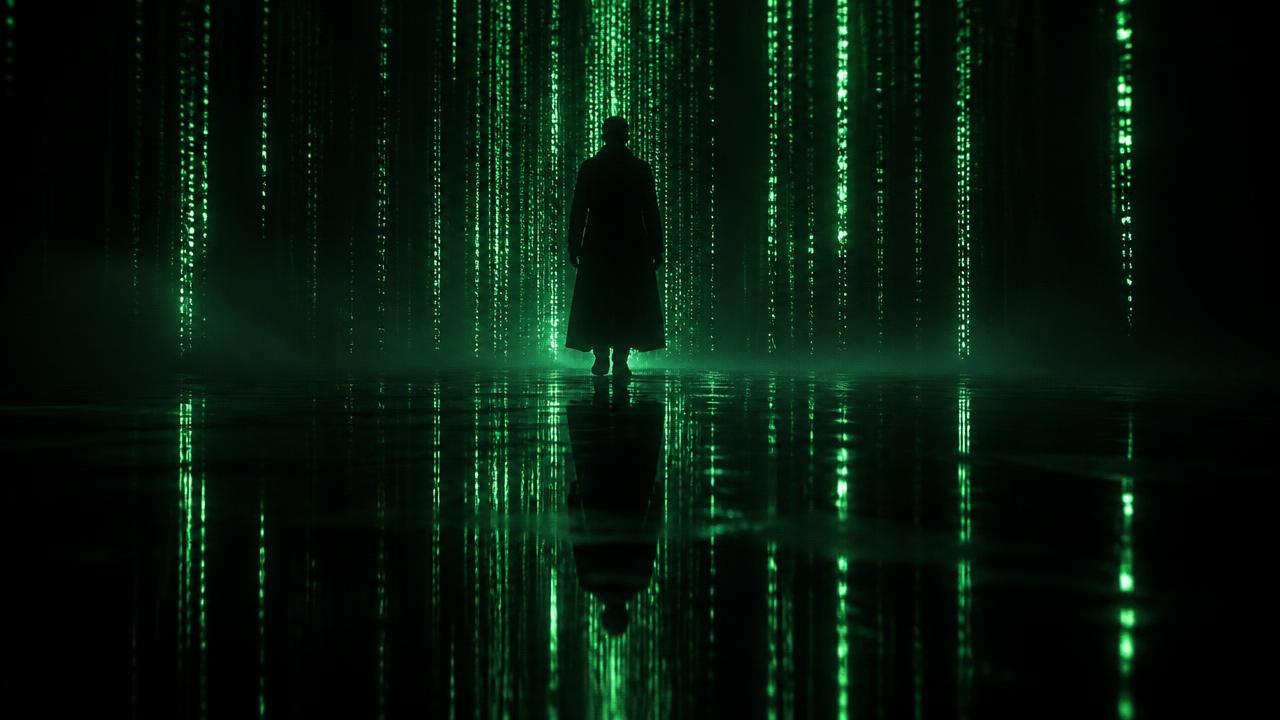
The Matrix
A protagonist told his ordinary reality is a manufactured cage.

The Shining
An unreliable interior slowly rewriting a man's identity.

Interstellar
Both hide a story about intimacy inside a story about systems.
Films that influenced this film
- The Graduate (1967)
- Brazil (1985)
- A Clockwork Orange (1971)
Films influenced by this film
- Mr. Robot (2015)
- Nightcrawler (2014)
- Joker (2019)
Music
Soundtrack
Where Is My Mind?
Pixies
Where it appears
Final scene, buildings falling
A song about dissociation plays over the moment dissociation ends. The irony is the point.
This Is Your Life
The Dust Brothers
Where it appears
Chemical burn sequence
Trip-hop percussion turns a torture scene into a lullaby about acceptance.
Corporate World
The Dust Brothers
Where it appears
Opening titles, through the narrator's brain
Synthetic, looping, machine-made — the sound of a life on autopilot.
Spoilers ahead
The ending
Spoiler warning
This section reveals the ending and its possible meanings.
Easter eggs
Hidden details
Small discoveries most viewers miss on a first watch.
Tyler appears four times before he exists
Single-frame splices at the doctor's office, the support group, the hotel and the escalator — the film plants him subliminally, the same technique Tyler uses at his projectionist job.
Starbucks cup in nearly every scene
Fincher has said a coffee cup is visible in almost every shot, a running gag about the ubiquity the film is attacking.
Cigarette burn cue marks
The reel-change cue marks Tyler explains later appear in the corner of the film you are actually watching.
The narrator's names
He gives a different fake name in every support group — he never has one of his own.
The debate
Competing interpretations
The goal is not a correct answer — it's finding out which reading people find most convincing.
FilmAbouts interpretation
0%
Community
What do you think the film is about?
Ranked automatically by community agreement.
Log in to add your own interpretation.