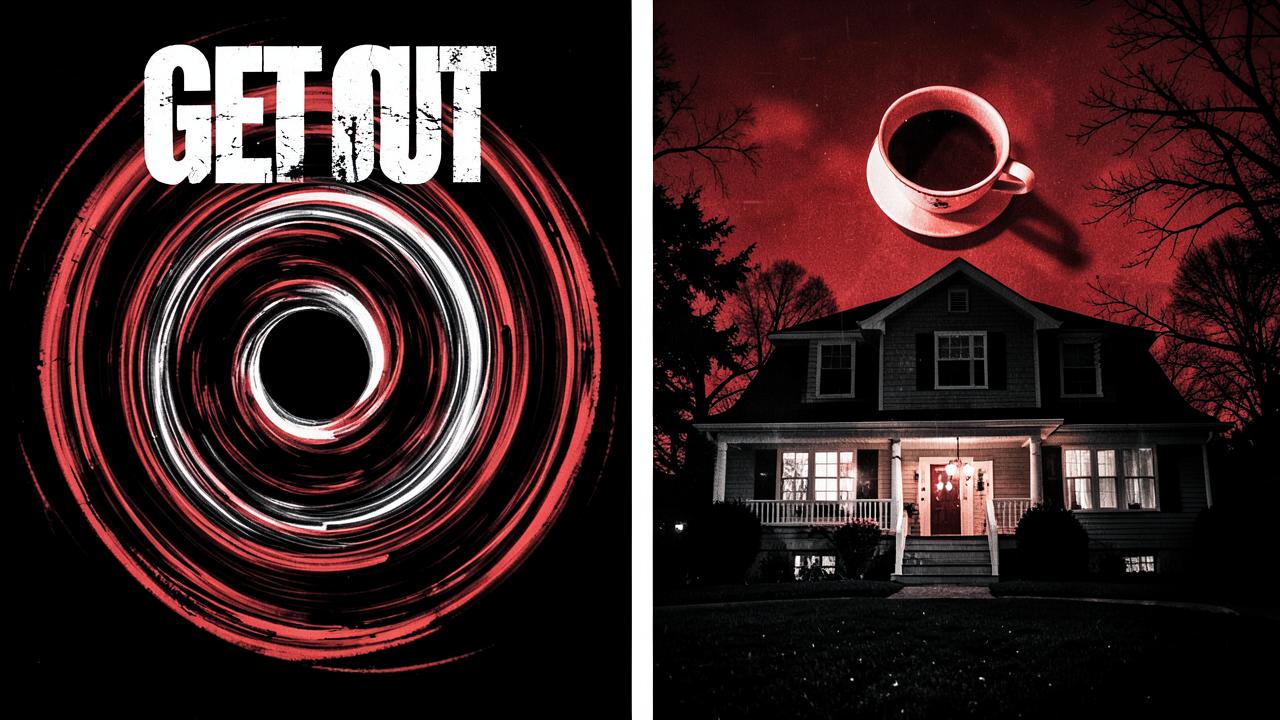
The central question
What is this film about?
Get Out is a horror film about being seen but not heard. Chris is surrounded by people who compliment him, photograph him, and treat his body as desirable real estate.
Peele turns microaggressions into plot. The Armitages are not cartoon racists; they are liberals who love Black culture and Black bodies while erasing Black minds. Their horror is politeness with a scalpel.
The sunken place is the film's central metaphor: a state of consciousness where you can see your own oppression but cannot stop it. It literalises the paralysis of being watched, consumed and silenced.
Chris's escape requires him to stop being polite. The film argues that survival sometimes means refusing the rules of hospitality that were designed to trap you.
Editorial reading
Written by the FilmAbouts editors. It is one reading among many — the community decides how convincing it is.
Do you agree?
0% agree · 100% disagree
Visual language
Symbols & visual language
Recurring elements, where they appear, and what they might mean.
The sunken place
Represents
Loss of bodily autonomy, silenced witness, racialised consumption.
Where it appears
Hypnotic trance triggered by Missy.
A state where the self is present but powerless, watching itself be used.
The teacup and spoon
Represents
Domestic ritual as weapon.
Where it appears
Missy's hypnosis.
The tools of polite hospitality become instruments of control.
Deer imagery
Represents
Chris as prey, hunted for sport and trophy.
Where it appears
The car accident, the mounted head, Rose's final aim.
Black bodies are treated as game by the Armitage family.
Cinematography
How the film looks
Red · White · Black · Forest green
Suburbia shot as a haunted house. Bright daylight, manicured lawns and friendly faces hide the violence.
- Dominant colours
- Red, white, black, forest green
- Lighting
- Natural daylight, warm interiors, sudden darkness
- Camera
- Stable wide shots, creeping zooms, intimate close-ups
- Composition
- Chris isolated in frame, surrounded by white space
- Aspect ratio
- 2.39:1
- Production design
- Suburban home as stage set for racial horror
- Recurring pattern
- Eyes, photographs, the sunken-place void
- Evolution
- From social comedy to survival thriller in one house
Lineage
What inspired the film?
Films, books, real events and culture that feed into it.
Connections
If you liked this film...
Parasite
A social ritual hides a violent class conspiracy.
The Shining
A domestic space becomes a trap that knows your fears.
Fight Club
Polite surfaces hide organised violence.
Films that influenced this film
- The Stepford Wives (1975)
- Rosemary's Baby (1968)
Films influenced by this film
- Us (2019)
- Antebellum (2020)
- The Invisible Man (2020)
Music
Soundtrack
Sikiliza Kwa Wahenga
Michael Abels
Where it appears
Opening and closing
A Swahili warning that translates roughly to 'Listen to your ancestors.'
Redbone
Childish Gambino
Where it appears
Opening credits
The lyrics 'Stay woke' become the film's instruction to the audience.
Spoilers ahead
The ending
Spoiler warning
This section reveals the ending and its possible meanings.
Easter eggs
Hidden details
Small discoveries most viewers miss on a first watch.
Rose's search
She eats cereal while searching for victims online, separating herself from the violence she enables.
The cotton saving Chris
He uses cotton from the chair stuffing to block his ears, a pointed reversal of plantation imagery.
The debate
Competing interpretations
The goal is not a correct answer — it's finding out which reading people find most convincing.
FilmAbouts interpretation
0%
Community
What do you think the film is about?
Ranked automatically by community agreement.
Log in to add your own interpretation.