Crime / Drama / Black comedy
Pulp Fiction
1994 · Quentin Tarantino
“A mosaic of Los Angeles criminals whose lives intersect through chance, choice and moral improvisation.”
The central question
What is this film about?
Pulp Fiction is less interested in what happens than in why people choose what they do when the script of their lives stops making sense.
Tarantino scrambles time so cause and effect no longer protect the characters. A hitman survives a miracle, then debates what it means. A boxer throws a fight and runs into the man he betrayed. A mobster's wife overdoses on a night out that should have been harmless.
The film keeps asking whether any of these people can change. Jules thinks he can. Vincent ignores the warning. Butch chooses honor over money. Mia simply wants to feel alive.
Beneath the violence and pop-culture dialogue, Pulp Fiction is a film about grace, coincidence and the small moments that decide whether someone lives or dies.
Editorial reading
Written by the FilmAbouts editors. It is one reading among many — the community decides how convincing it is.
Do you agree?
0% agree · 100% disagree
Visual language
Symbols & visual language
Recurring elements, where they appear, and what they might mean.
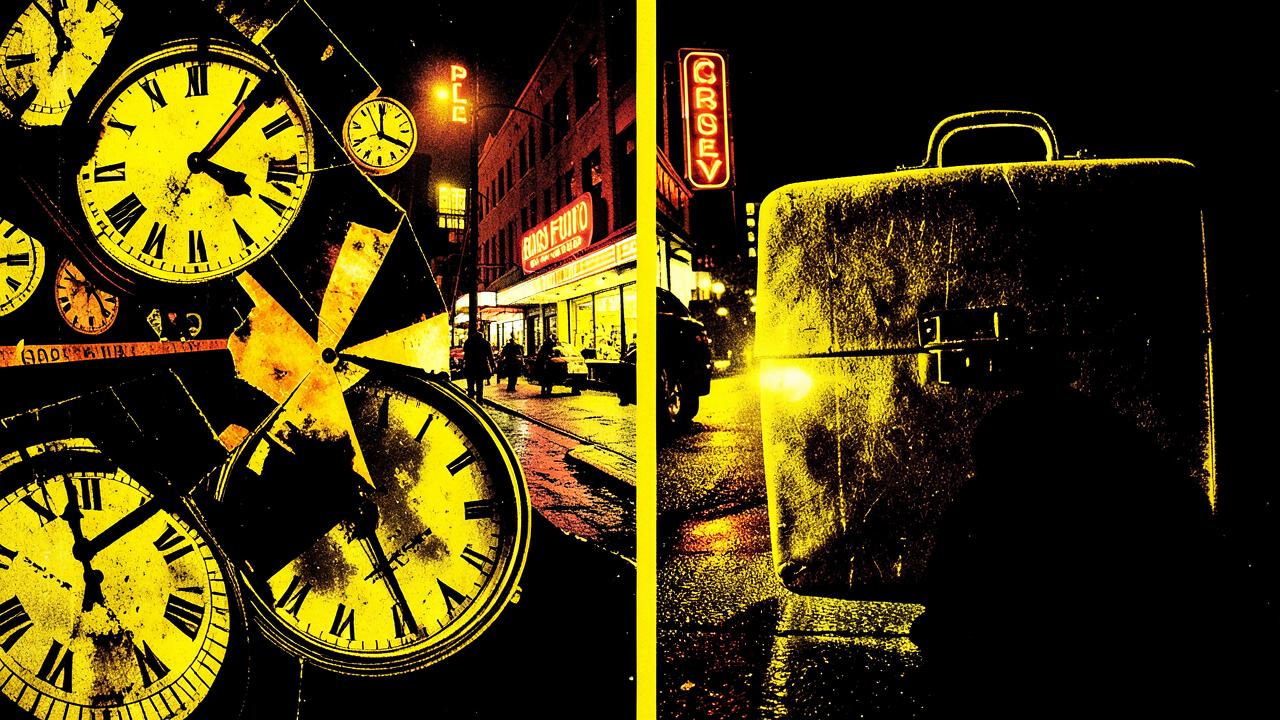
The briefcase
Represents
Desire, the MacGuffin, possibly redemption or the soul.
Where it appears
Carried by Vincent and Jules; opened by Marsellus; glows with something unseen.
What matters is not what is inside, but what people are willing to do to possess it.
The wristwatch
Represents
Inherited duty, masculinity, the weight of the past.
Where it appears
Butch's father and Captain Koons narrate its survival through war and imprisonment.
Butch does not fight for money; he fights because the watch makes honor feel like family obligation.
The adrenaline shot
Represents
Second chances, abrupt resurrection.
Where it appears
Mia collapses and is revived by a needle to the heart.
A literal wake-up call: life can be lost and restored in the same absurd instant.
Cinematography
How the film looks
Black · Red · Gold · Smoke grey
High-contrast colour with pop-art framing, diner neon, blood that reads like paint, and a deliberately theatrical use of shadow.
- Dominant colours
- Black, red, gold, smoke grey
- Lighting
- Hard practicals, neon glow, theatrical shadows
- Camera
- Restless but controlled handheld and tracking
- Composition
- Cluttered, conversational two-shots
- Aspect ratio
- 2.39:1
- Production design
- Diners, apartments and cars from a heightened 1990s LA
- Recurring pattern
- Conversations that turn into stand-offs
- Evolution
- Colour temperature warms as the chronology folds
Lineage
What inspired the film?
Films, books, real events and culture that feed into it.
Film
Kiss Me Deadly (1955)
The glowing briefcase MacGuffin.
Film
Rififi (1955)
The un-chronological heist structure.
Book
Pulp magazines and hardboiled fiction
The episodic, morally flexible storytelling style.
Culture
Biblical passage Ezekiel 25:17
Jules' misquoted speech becomes a meditation on judgment and mercy.
Connections
If you liked this film...
Fight Club
Moral improvisation and identity under pressure.
The Godfather
Crime as a system of honour and inheritance.
Get Out
A tightly wound plan unravels through social ritual.
Films that influenced this film
- Kiss Me Deadly (1955)
- Rififi (1955)
Films influenced by this film
- Snatch (2000)
- Lock, Stock and Two Smoking Barrels (1998)
- Boogie Nights (1997)
Music
Soundtrack
Misirlou
Dick Dale
Where it appears
Opening credits
Surfer-rock overture that announces the film as a remix of borrowed culture.
Son of a Preacher Man
Dusty Springfield
Where it appears
Vincent buys heroin
Ironically frames addiction as seduction.
You Never Can Tell
Chuck Berry
Where it appears
Jack Rabbit Slim's twist contest
A moment of pure joy before the overdose.
Spoilers ahead
The ending
Spoiler warning
This section reveals the ending and its possible meanings.
Easter eggs
Hidden details
Small discoveries most viewers miss on a first watch.
The diner bookends
The film opens and closes on the same diner robbery, but the second time we understand Jules' transformation.
No answer on purpose
We never see the briefcase contents because the film wants us to project our own greed onto it.
The debate
Competing interpretations
The goal is not a correct answer — it's finding out which reading people find most convincing.
FilmAbouts interpretation
0%
Community
What do you think the film is about?
Ranked automatically by community agreement.
Log in to add your own interpretation.