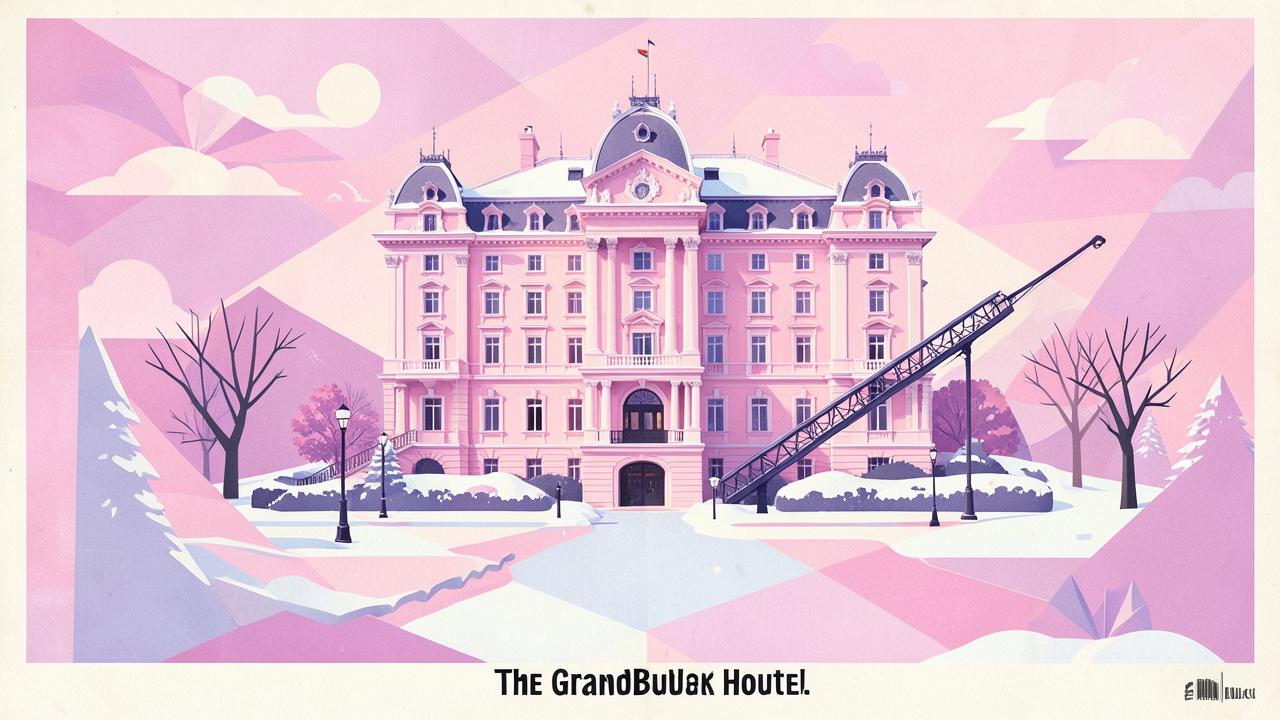
Comedy / Drama / Adventure
The Grand Budapest Hotel
2014 · Wes Anderson
“A legendary concierge and his loyal lobby boy fight to prove his innocence after a wealthy guest is murdered.”
The central question
What is this film about?
The Grand Budapest Hotel is a film about the end of an era, told as a confection. M. Gustave represents a refined Europe that is about to be destroyed by fascism, greed and bad manners.
Anderson uses aspect ratio to tell time: the 1980s frame is widescreen, the 1960s memory is Academy ratio, and the 1930s story is boxy 1.37:1. The past becomes smaller and more precious as it recedes.
Beneath the pastel comedy is real mourning. The hotel survives, but its elegance is gone. Zero keeps it running as a monument to a world that no longer exists.
The film asks whether beauty and courtesy matter when the world is collapsing. Gustave's answer is yes, absolutely, and he dies proving it.
Editorial reading
Written by the FilmAbouts editors. It is one reading among many — the community decides how convincing it is.
Do you agree?
0% agree · 100% disagree
Visual language
Symbols & visual language
Recurring elements, where they appear, and what they might mean.
The hotel
Represents
Old Europe, civility, a disappearing class system.
Where it appears
The central location in every time period.
A beautiful machine for preserving a world that is being murdered by history.
The painting Boy with Apple
Represents
Wealth, legacy, the absurdity of inheritance.
Where it appears
Stolen, hidden, fought over.
The McGuffin that exposes how greed dissolves elegance.
Aspect ratio changes
Represents
Memory compressing the past.
Where it appears
Each era has its own frame shape.
The further back in time, the more contained and idealised the world becomes.
Cinematography
How the film looks
Pink · Purple · Cream · Red
Symmetrical framing, miniatures, pastel colours and deliberate theatrical artifice.
- Dominant colours
- Pink, purple, cream, red
- Lighting
- Even, bright, storybook illumination
- Camera
- Planimetric, lateral tracking, whip pans
- Composition
- Centred, symmetrical, dollhouse-like
- Aspect ratio
- 1.37:1, 1.85:1 and 2.39:1 by era
- Production design
- Miniature hotel, painted backdrops, period detail
- Recurring pattern
- Doors, windows, frames within frames
- Evolution
- Colour and aspect ratio shrink as the past recedes
Lineage
What inspired the film?
Films, books, real events and culture that feed into it.
Connections
If you liked this film...
Pulp Fiction
A mosaic of stories held together by style.
The Godfather
A world of ritual and inheritance.
Parasite
Architecture as a map of class.
Films that influenced this film
- The Shop Around the Corner (1940)
- Stefan Zweig
Films influenced by this film
- The French Dispatch (2021)
- Palm Springs (2020)
Music
Soundtrack
Mr. Moustafa
Alexandre Desplat
Where it appears
Zero's arrival at the hotel
A balalaika-driven theme that feels like a memory trying to dance.
Canto at Gabelmeister's Peak
Alexandre Desplat
Where it appears
The alpine chase
A tense lullaby that matches the film's snowbound colour palette.
Spoilers ahead
The ending
Spoiler warning
This section reveals the ending and its possible meanings.
Easter eggs
Hidden details
Small discoveries most viewers miss on a first watch.
The prison escape
Anderson studied classic prison films and shot the sequence as a meticulously choreographed ballet.
Stefan Zweig dedication
The film is dedicated to the Austrian writer whose suicide in exile haunts the story.
The debate
Competing interpretations
The goal is not a correct answer — it's finding out which reading people find most convincing.
FilmAbouts interpretation
0%
Community
What do you think the film is about?
Ranked automatically by community agreement.
Log in to add your own interpretation.